Thailand’s International Relations 2025
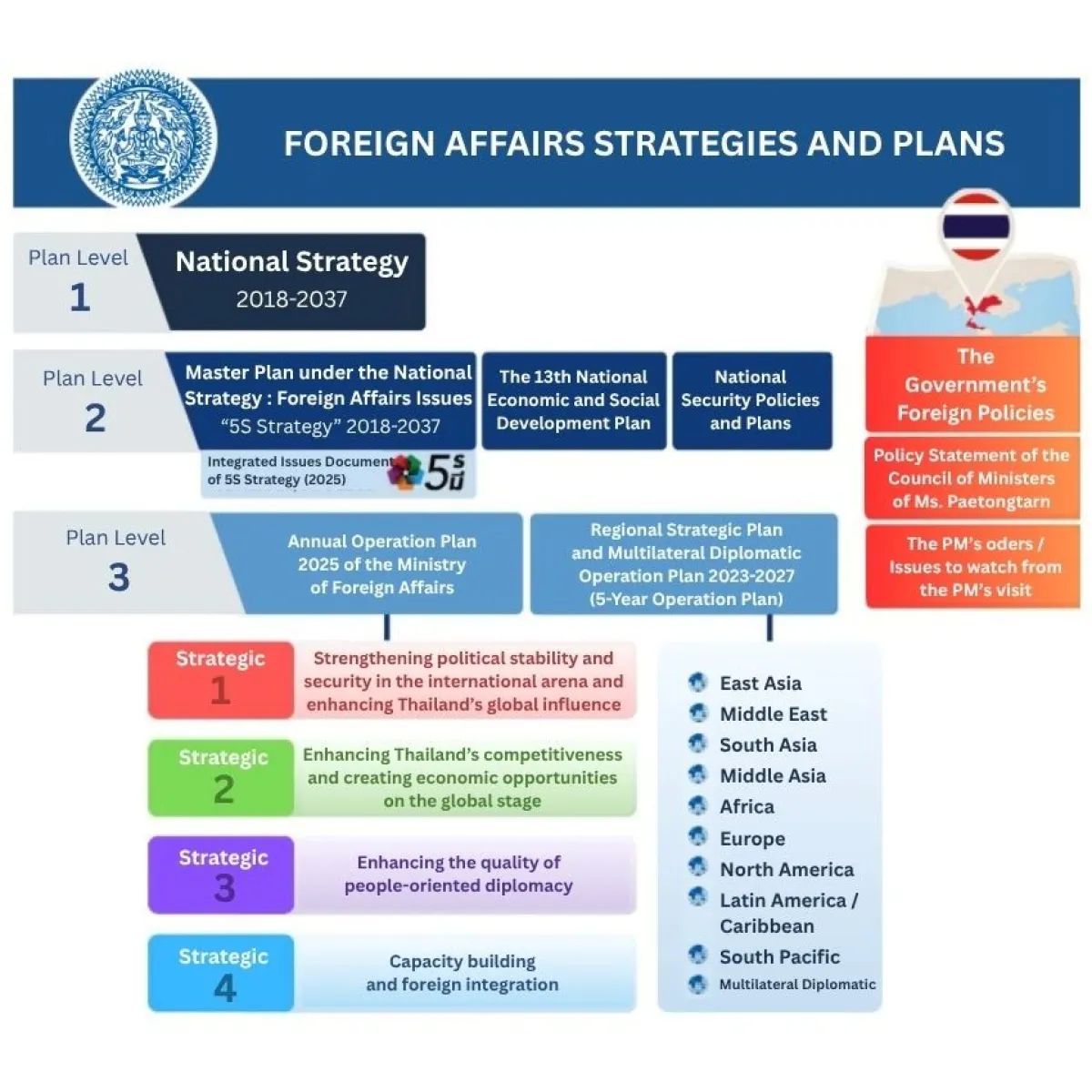
Primary Policy
· Adhering to a foreign policy rooted in the principle of Strategic Neutrality
· Driving the 5S Strategy, which means Security, Sustainability, Standard, Status, and Synergy
· Promoting the Proactive Economic Diplomacy Strategy to expand economic opportunities
· Strengthening strategic cooperation with countries that significantly contribute to the global economy.
· Expanding proactive roles in significant international organizations such as the Organisation for Economic Co-operation and Development (OECD), the World Economic Forum (WEF), and the Gulf Cooperation Council (GCC)
· Cultivating Thai Soft Power to foster cooperation and strengthen national image
Concrete Cooperation
Bilateral Relations
· Thailand-China: 50th Anniversary of Diplomatic Relations / Comprehensive Strategic Partnership / Bangkok-Kunming High-Speed Railway / Digital Economy, Trade, Tourism, and Culture
· Thailand-Japan: Long-term Economic Partnership / EV / Green Technology / Smart Infrastructure / Human Resources Development
· Thailand-South Korea: Comprehensive Strategic Partnership / Cooperation in Technology, Innovation, Startup, Soft Power, and Culture
· Thailand-Indonesia: 75th Anniversary of Diplomatic Relations / Strategic Partnership / Trade, Energy, and Education Cooperation
· Thailand-Vietnam: Preparing to upgrade their strategic partnership to a Comprehensive Strategic Partnership
· Thailand-United States: Expanding the Indo-Pacific Economic Framework (IPEF) cooperation on cybersecurity, Artificial Intelligence (AI), clean energy, Defense, and Multilateral Nuclear Non-proliferation Agreements (MNNA)
Multilateral Cooperation
· Thailand–ASEAN (Association of Southeast Asian Nations): Promote trade, investment, and the digital economy through the ASEAN Economic Community (AEC) and the Regional Comprehensive Economic Partnership (RCEP); foster cooperation in logistics to mitigate disasters through the Disaster Emergency Logistics System for ASEAN (DELSA) Center
· Mekong–Lancang Cooperation (MLC): Strengthen Economic and Development Cooperation
· ASEAN+3: Cooperate on Clean Energy, Public Health, Climate and Disasters
· Thailand–EU (European Union): Begin negotiations for the Free Trade Agreement (FTA) to enhance cooperation in the Green Economy, Carbon, Artificial Intelligence (AI), and Medicine sectors
· Thailand–Africa: Expand TICA’s (Thailand International Cooperation Agency) cooperation in Medicine, Smart Agriculture, Disaster Management, and Food Security
· Thailand–Latin America: Initiate discussions with Mercosur regarding Agricultural, Food, and Logistics Cooperation with Chile and Peru
· OECD: Processing the membership application with the Organisation for Economic Co-operation and Development (OECD) and aim to achieve in 2030
· WEF (World Economic Forum): Driving cooperation in the Digital Economy, Artificial Intelligence (AI), Smart Agriculture and Creative Economy
· GCC (Gulf Cooperation Council): Expanding cooperation in trade, investment, energy and negotiating Free Trade Agreement (FTA)
Key Objectives
Positioning Thailand as a central hub for cooperation in the ASEAN region
Enhancing economic competitiveness through innovation
Expanding markets and attract investment into the Asia-Pacific region
Fostering stability and confidence in geopolitics with a balanced approach
Elevating national economic system standards in line through the OECD
Establishing Thailand as a nation of balanced, creative, and sustainable cooperation
Summary
Primary Policy
During 2024-2025, Thailand is implementing its foreign policy based on the principle of Strategic Neutrality, focusing on emphasizing the maintenance of a constructive balance of relations with all countries. This approach aims to maximize national and global benefits from Thailand’s role on the world stage, guided by the 5S Strategy: Security, Sustainability, Standard, Status, and Synergy.
In terms of Security, Thailand promotes its stability in the areas of economy, cross-border security, cyber security, food security, energy and public health. Under Sustainability, Thailand is accelerating economic development with green technology, and an innovative and a low-carbon economy. Regarding Standard, Thailand is determined to improve regulations and laws on trade, investment and governance to be in line with international standards, especially in the process of joining the Organisation for Economic Co-operation and Development (OECD). Under Status, Thailand enhances its international presence by nominating Thais for important positions, including hosting important forums. Lastly, in terms of Synergy, Thailand integrates and fosters the implementation of international policies together among the public, private, and civil sectors.
Under this strategy, Thailand has promoted a Proactive Economic Diplomacy Strategy to expand economic opportunities and strengthen strategic cooperation with influential global economies. This strategy also involves actively participating in international organizations like the OECD, GCC, and WEF, and developing Thai Soft Power as a mechanism to promote economic, cultural cooperation, and enhance the country’s global image.
Concrete Cooperation
Bilateral Relations
· Thailand–China: In 2024, Thailand and China established a Five-Year Operation Plan for Long-Term Cooperation, aiming to expand collaboration in key areas such as logistics, digital trade, traditional Chinese medicine, and infrastructure connectivity. In 2025, on the occasion of the 50th anniversary of diplomatic relations, the two countries continue elevating their Comprehensive Strategic Cooperative Partnership. A centerpiece of this enhanced relationship is the Bangkok–Kunming High-Speed Railway Project, recognized as a critical strategic infrastructure initiative. Additionally, both nations will deepen cooperation in E-commerce, investment in the Eastern Economic Corridor (EEC), tourism, culture, and student exchange programs.
· Thailand–Japan: Thailand and Japan continue to deepen and expand their cooperation. In 2024, both countries enhanced the Japan–Thailand Economic Partnership Agreement (JTEPA) by incorporating new areas of collaboration, including green hydrogen, electric vehicles (EVs), the circular economy, AI, and advanced technology transfer. Ongoing investment initiatives in the EEC will be sustained, alongside the launch of a human capability development program in technology and the digital industries in 2025.
· Thailand–South Korea: In 2024, Thailand and South Korea signed a cooperation agreement focused on Startup development and Soft Power innovation. Building on this foundation, the two countries elevated their relationship to a Comprehensive Strategic Partnership in 2025. This enhanced partnership encompasses cooperation in AI, robotics, and intelligent transportation systems, as well as the music, gaming, and film industries, alongside collaborative research in the digital economy.
· Thailand–Indonesia: In 2024, Thailand and Indonesia established a framework for expanding their cooperation in key areas such as logistics, renewable energy, halal food, and education. In 2025, on the occasion of the 75th anniversary of diplomatic relations, the two nations will formalize a Strategic Partnership, with a focus on advancing cooperation in the halal economy, logistics, agriculture, biotechnology, and human resource development.
· Thailand–Vietnam: Beginning in 2024, Thailand and Vietnam initiated preliminary discussions to elevate their relationship. In 2025, both countries will accelerate talks to enhance cooperation in key strategic areas, including EVs, smart agriculture, cross-border supply chain development, green economy transition, and logistics.
· Thailand–United States: In 2024, Thailand actively participated in advancing economic cooperation under the Indo-Pacific Economic Framework (IPEF), with a focus on supply chain, cybersecurity, AI, and clean energy. In 2025, the partnership is expected to progress further in the areas of digital investment and a low-carbon economy.
Multilateral Cooperation
· Thailand–ASEAN (Association of Southeast Asian Nations): Thailand has aimed to maintain its leadership role within the ASEAN framework during 2024-2025. Economic cooperation is a key focus, particularly through the ASEAN Economic Community (AEC) and the Regional Comprehensive Economic Partnership (RCEP) Agreement, of which Thailand is a significant participant. Regional cooperation encompasses various areas, including infrastructure development, post-COVID-19 recovery, the establishment of the ASEAN Digital Economy Framework Agreement (DEFA), and strengthening shared food security. Thailand has actively contributed to these efforts by proposing agricultural innovation and digital technology to support the regional economy in the long term. Furthermore, Thailand hosts the DELSA (Disaster Emergency Logistics System for ASEAN) Center in Chai Nat Province.
· Thailand–EU (European Union): Thailand and the EU officially commenced the Free Trade Agreement (FTA) negotiation process after a decade-long hiatus in 2024, and in 2025, the progress has been made in expanding cooperation in various areas, including the Green Economy, Carbon Market, Green Hydrogen, AI, Circular Economy, and Medical Innovation Collaboration.
· Thailand–Africa: In 2024, Thailand commenced expanding its Thailand Incentive and Convention Association (TICA) cooperation project with countries in Sub-Saharan Africa. Which in 2025, this expansion will include medicine, smart agriculture technology, disaster management, and food security.
· Thailand–Latin America: In 2024, Thailand initiated Proactive Trade Discussions with the South American Common Market (Mercosur). In 2025, Thailand will enhance cooperation in agriculture, the food industry, and logistics with Chile and Peru.
· OECD: Thailand has entered to membership application process with the OECD. In 2025, Thailand is preparing an Initial Memorandum and is in the process of discussing with the OECD Board to enter the negotiation process for full membership status by 2030.
· WEF: Thailand has been proactive since 2024 by proposing the concept of a green economy and digital transformation to the World Economic Forum. In 2025, Thailand presented cooperation guidelines on the digital economy, AI, smart agriculture, a clean supply chain system, and a soft power platform at the world leaders’ forum.
· GCC: From the policy discussions in 2024, cooperation in trade, clean energy, halal food, wellness tourism, and medical innovation with the GCC has led to tangible progress towards FTA negotiations in 2025.
Key Objectives
Thailand seeks to become a hub of cooperation within the ASEAN region, leveraging economic connectivity, infrastructure, and trade networks as pivotal bases. Simultaneously, the country emphasizes enhancing economic competitiveness by promoting industries that embrace advanced technology and innovation, particularly in the digital economy, clean energy, and automotive sectors. Furthermore, Thailand aims to expand trade and investment markets in electricity and modern medicine, as well as venture into new regions beyond traditional partners, such as the Middle East, Latin America, and Africa. This expansion strategy aims to mitigate risks and present fresh opportunities for Thai entrepreneurs.
Thailand has pursued a foreign policy that emphasizes geopolitical balance and maintains Strategic Neutrality to foster the stability and confidence of the country amidst global superpower competition. Simultaneously, the country has taken steps towards international economic standards by applying to join the OECD. This process aims to elevate Thailand’s policy, economic, and regulatory systems to align with those of developed countries in the future.
By implementing these policies, Thailand has established a strong image on the international stage. The country is now ready to collaborate with all parties on the principles of cooperation, balance, creativity, and sustainability. This approach aligns with Thailand’s long-term goal of playing a constructive role in the region and the global stage.
Outcomes from Advancing International Cooperation
Thailand’s foreign policy implementation, guided by the Strategic Neutrality approach and the expansion of cooperation with foreign partners, has yielded overall positive outcomes for the country and its people. These outcomes encompass economic growth, technological advancements, and skill development opportunities.
For instance, cooperation between Thailand and ASEAN in 2024-2025 led Thailand to take a prominent role in advocating for the ASEAN Digital Economy Framework Agreement (DEFA). This agreement, jointly endorsed at the ASEAN Leaders’ Meeting in September 2023, is currently being accelerated in 2025 and is expected to be a pivotal mechanism for enhancing e-commerce in the region. In terms of security, Thailand is hosting the Disaster Emergency Logistics System for ASEAN (DELSA) in Chai Nat Province. DELSA delivered emergency supplies to member countries on several occasions throughout 2024. It also serves as a crucial infrastructure for ASEAN in response to systemic crises.
The operation information is disseminated through the AHA Centre, which functions as the center of disaster cooperation in ASEAN under the support of the Thai government. Regarding Thai-Japan and Thai-South Korea cooperation, it fosters investment in EVs and green technology, thereby creating new job opportunities and promoting domestic industrial development. Cooperation with GCC countries and Latin America supports the export of Thai halal food and agricultural products to new markets, leading to continuous expansion of trade opportunities for Thai farmers and entrepreneurs. Accelerating FTA negotiations with the European Union, including pushing Thailand into the process of becoming a member of the OECD, also helps raise the country’s standards and build confidence in the international economic arena.
During 2024-2025, these collaborations have yielded tangible results, such as continuous increases in the value of processed food exports from Thailand to the GCC and Latin America. Additionally, investments from Japan and South Korea in the electric vehicle industry and clean energy have led to the creation of new jobs and technology transfer. Academic cooperation projects with China and Japan have provided opportunities for Thai youth to access scholarships and knowledge in science and technology. Cooperation with Indonesia has focused on Halal food standards and food security, which has helped strengthen the potential of Thai entrepreneurs in the regional Halal market. In essence, Thai people have benefited from increased employment, new skills development, educational opportunities abroad, increased income for farmers, and access to new export markets in the region and globally.
References
• World Economic Forum (WEF). (2025). Summary Report of Thailand's role in the WEF Annual Meeting 2025.
• ASEAN Secretariat. (2567). ASEAN Key Figures 2024.
• Ministry of Foreign Affairs. (2023). Master Plan under the National Strategy on Foreign Affairs Issues (2023–2037) (Revised Edition).
• Ministry of Foreign Affairs. (2024). Annual Operation Plan of the Ministry of Foreign Affairs for Fiscal Year 2024.
• Ministry of Foreign Affairs. (2025). Annual Operation Plan of the Ministry of Foreign Affairs for Fiscal Year 2025.
• Ministry of Foreign Affairs. (2023). Master Plan under the National Strategy on Foreign Affairs Issues (2018-2037) (Original Edition).
• Government House. (2025). Press Conference on the 50th Anniversary of Thai-Chinese Cooperation.
• Government House. (2025). Press Conference on the 75th Anniversary of Thai-Indonesian Cooperation.
• Government House. (2025). Progress Report on the OECD Application Process.
• Office of the International Economic Policy Committee (OIE) (2025). Summary Report on Thailand's Cooperation with the GCC, EU, and Mercosur.
• Thailand Incentive and Convention Association (TICA). (2025). Report of the Thai-African Cooperation Project.
• Ministry of Commerce. (2024). Progress Report on Thailand-EU FTA Negotiations.
• Ministry of Commerce. (2025). Progress Report on Thailand-GCC FTA Negotiations.
• Ministry of Commerce. (2024). Report on the Thai-ASEAN Trade Situation.
• Trade Policy and Strategy Office (TPSO). (2024). Analysis of Trends in Thailand's International Trade.
• Disaster Emergency Logistics System for ASEAN (DELSA) Center, Chai Nat Province, 2024; ASEAN Coordinating Centre for Humanitarian Assistance (AHA Centre), 2024】.