Q&A Daily Communication Responses (18 January 2026)
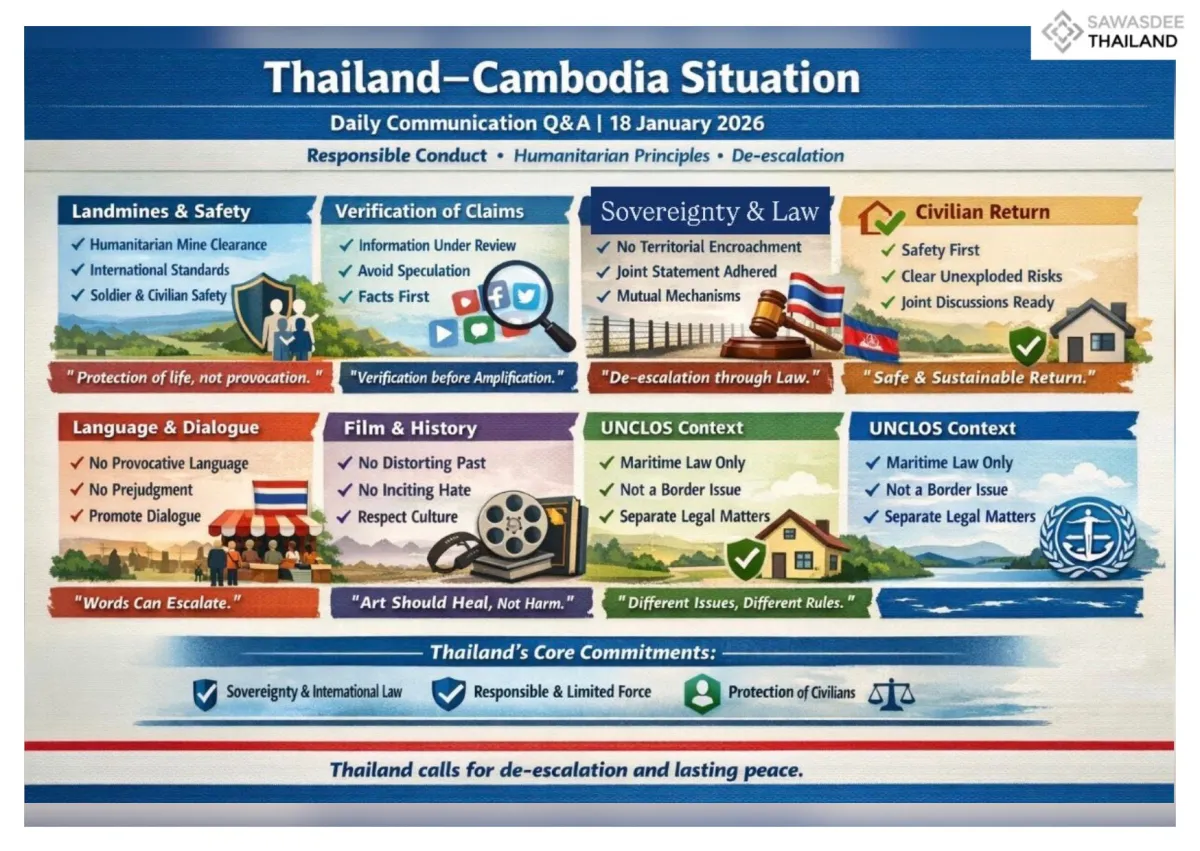
Q&A Daily Communication Responses (18 January 2026)
---------------------------------
Q1: How does Thailand respond to the discovery of a large number of landmines in the border area?
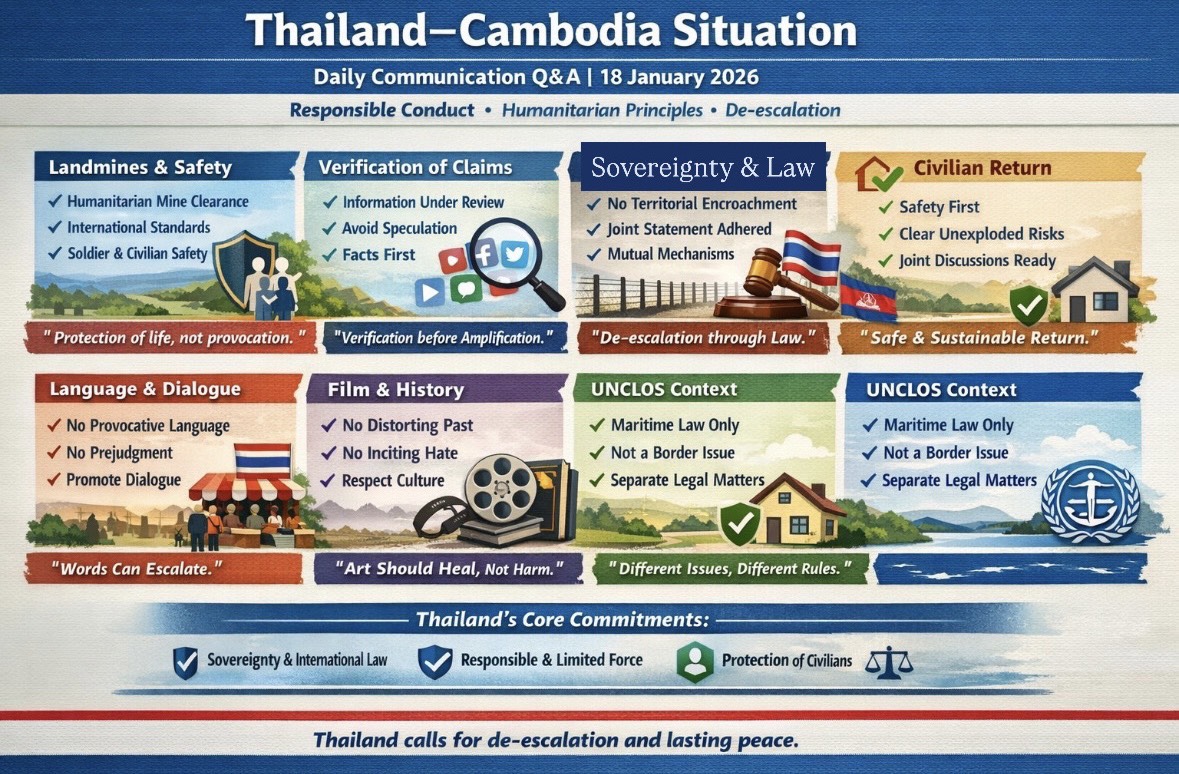
A: Thailand places the highest priority on the safety of its soldiers and civilians in the border areas. The discovery of explosive devices was the result of humanitarian operations undertaken by the responsible Thai agencies, conducted transparently and in accordance with international standards. Thailand reiterates that mine clearance operations are aimed at protecting civilian lives and reducing risks in the area. This should not be construed as an aggressive or provocative military action, as we remain ready for joint inspections within appropriate mechanisms.
Q2: How is Thailand addressing concerns that Thai soldiers are at risk from a large number of landmines?
A: The Royal Thai Armed Forces has increased risk prevention measures in terms of tactics, equipment, and specialized training to ensure that operations are conducted with the utmost caution. We reiterate that the primary mission is to defend sovereignty while protecting lives, adhering to the highest principles of humanitarianism and responsible conduct.
Q3: Regarding the dissemination of images and stories concerning Cambodian suicide drones, what is Thailand’s view?
A: Thailand notes the information circulating on social media and is currently conducting a thorough investigation. In principle, Thailand wishes to avoid elaborating on information that has not been officially verified, and requests that the media and the public exercise discretion in receiving and engaging with information to avoid misunderstandings or unnecessary escalation.
Q4: How will Thailand respond to complaints from villagers and border market vendors regarding official inspections?
A: The actions of the Thai officials are in accordance with the law and measures to maintain peace. and order during highly sensitive situations. The concerns of the people are taken into consideration while the Thai officials remain ready to investigate the facts to avoid any unnecessary impact on people’s livelihoods. At the same time, overall security and safety are paramount.
Q5: How does Thailand respond to Cambodia’s accusations of “aggression” and seizing Cambodian land?
A: Thailand categorically denies these accusations. Thailand has always exercised its inherent right to protect its own sovereignty without encroaching on the territory of other countries. The troops that remain along the troop deployment line are there to maintain security in the area and as a de-escalation measure consistent with paragraph 2 of the Joint Statement recently agreed upon by both sides on 27 December 2025. Any further accusations should be addressed within mechanisms accepted by both sides, not through accusations made unilaterally in the media or social media.
Q6: Cambodia claims that Thailand’s actions violate the agreement for civilians to return the area (paragraph 4). Is this true?
A: Thailand reiterates that it remains firmly committed to the Joint Statement and strictly abides by humanitarian principles. Any actions taken in the area are primarily aimed at ensuring the safety of civilians, especially in areas still at risk from weapons or explosives that remain in the area. Thailand remains ready to discuss within the appropriate joint mechanisms how to ensure the safe, dignified, and sustainable return of civilians.
Q7: Cambodian media requested the use of the term “Thailand invaded Cambodia.” What is Thailand’s reaction?
A: Thailand calls on all parties to use language that is constructive, non-provocative, and non-discriminatory. Inflammatory and unfounded statements unjustly implicate one side may complicate the situation and undermine efforts to de-escalate tensions. Thailand supports language and statements that reflect the facts and supports the resolution of issues through dialogue.
Q8: How does Thailand respond to serious accusations made against Thailand in the film “Ghost Mountain: Second Killing Field”?
A: Thailand notes the information and accusations contained in the film and underlines that filmmaking should not be used to distort history or incite hatred. Thailand believes that any representation of conflict should be based on verifiable facts and also consider the impact on the relations between the people of both countries.
Q9: Does Cambodia’s ratification of UNCLOS have any implications for the border situation?
A: No. Ratifying the United Nations Convention on the Law of the Sea (UNCLOS) relating to the framework of maritime law is the right of any State Party. Thailand views this as an unrelated issue that should not be linked or used as a reason for escalating border tensions. Each issue should be considered within their appropriate framework.
Q10: What is the main message that Thailand wishes to communicate to the international community?
A: Thailand is committed to:
• Protecting sovereignty in accordance with international law
• Use of force, only as necessary and in a limited and responsible manner
• Protecting civilians and upholding humanitarian principles
• Resolving issues through negotiation and mutually acceptable mechanisms
Thailand calls on all parties to work together to de-escalate tensions and strive for lasting peace.
---------------------------------
The Joint Information Center on the Thailand - Cambodia Situation
18 January 2026 at 13:00 hrs