Opening Statement of H.E. Mr. Sihasak Phuangketkeow, Deputy Prime Minister and Minister of Foreign Affairs of the Kingdom of Thailand at the First Meeting of the Conciliation Commission, 15 September 2026, Singapore
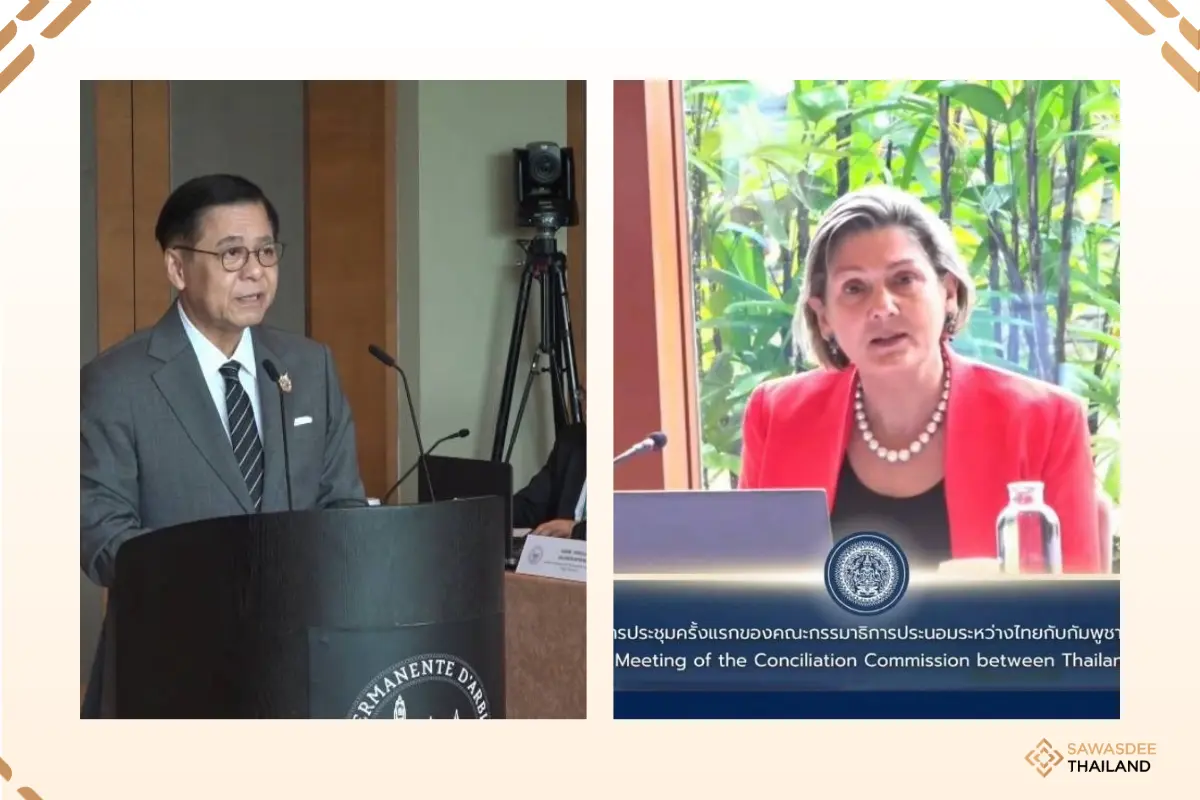
Opening Statement of H.E. Mr. Sihasak Phuangketkeow, Deputy Prime Minister and Minister of Foreign Affairs of the Kingdom of Thailand
First Meeting of the Conciliation Commission, 15 September 2026, Singapore
Madam Chair,
Distinguished Members of the Conciliation Commission, and the representatives of the Kingdom of Cambodia,
1. It is my honour to represent the Kingdom of Thailand. I am here with a clear purpose: to seek a solution on maritime delimitation that protects our rights and enables Thailand and Cambodia to move forward as neighbours.
2. At the outset, permit me to address the broader context of the relations between Thailand and Cambodia, which I believe is very pertinent to our meeting today.
3. There is a need to understand the circumstances and the course of events that have led us here to Singapore. At the heart of this process is a stark divergence in how Thailand and Cambodia have chosen to manage the issues between us.
4. Thailand has consistently believed that differences between neighbours should be addressed through dialogue. That has been our approach throughout: to keep channels open, rebuild confidence, and seek sustainable solutions through bilateral negotiations.
5. But Cambodia has approached the issues differently. It always claims that it respects international law and portrays Thailand as flouting it. But its claims are self-serving and contain elements of hypocrisy.
6. We should recall the events that precipitated the conflict.
7. When Cambodia leaked a private telephone conversation between our leaders, when Cambodian rockets hit and killed innocent Thai civilians, and when our soldiers lost their legs to landmines planted by Cambodia, where was respect for international law?
8. Let me be clear. Thailand’s commitment to international law is unwavering. We firmly uphold the rules-based international order and will defend our rights within it.
9. For Thailand, international law and diplomacy are complementary foundations of peaceful relations between States. Law provides the framework. Diplomacy enables neighbours to apply that framework, build trust and confidence, and arrive at acceptable and sustainable solutions.
10. This matters all the more now because our relationship has been through a difficult period. Conflicts have damaged trust and taken a heavy toll on communities on both sides.
11. But if we want a real chance at finding sustainable solutions, we must rebuild that trust. Thailand has therefore pursued dialogue and a pragmatic approach to create the confidence needed to tackle harder issues.
12. At the ASEAN Summit in Cebu earlier this year, our leaders reaffirmed their commitment to gradually restore relations.
13. And when I met my Cambodian counterpart, H.E. Deputy Prime Minister Prak Sokhonn, in New York in May, I proposed practical step-by-step measures to advance that commitment. These would have built confidence and enabled us to confidently move forward on the contentious issues before us.
14. Regrettably, that pragmatic approach of diplomacy has never been given a real chance by Cambodia. And from Thailand’s perspective, this reflects a troubling pattern in Cambodia’s approach.
15. Instead of engaging fully and sincerely through bilateral dialogue, Cambodia has repeatedly vilified Thailand through false narratives, distortion of facts and unfounded accusations against us, almost on a daily basis, including at international forums. And it does this by playing the role of a victim with a sense of self-righteousness aimed at claiming the moral high ground.
16. We cannot ignore how domestic political considerations in Cambodia have shaped this pattern. For us, relations between our two countries — and the welfare of citizens on both sides — should never be made subject to short-term political calculations.
17. This is the path that Cambodia has chosen all along. Such an approach bears heavy consequences. It inflames public sentiment, deepens tensions, and hardens positions. This makes the accommodation and reconciliation that both countries need even more difficult.
18. The path that Thailand has sought to pursue is one in which recourse to legal means is accompanied by clear-eyed diplomacy to build trust. Diplomacy must not become a contest in one-upmanship that seeks unilateral advantage.
Termination of the 2001 MOU
19. Madam Chair, members of the Commission, the work ahead of us requires an accurate account of how we arrived here. I therefore wish to briefly address Cambodia’s portrayal of Thailand’s decision to terminate the 2001 MOU.
20. Cambodia suggests that Thailand’s decision to terminate the MOU left it with no option but to initiate these proceedings. This is simply not true.
21. The truth is that, over a period of twenty-five years, we managed to hold only two rounds of official talks. It is clear that the MOU had produced no concrete progress. Thailand therefore chose to give negotiations a fresh start.
22. Cambodia’s very recent ratification of UNCLOS would have provided a timely opportunity to resume talks on a common and firmer legal basis.
23. Thailand expressly offered that path. I personally proposed to my counterpart that we begin direct talks on the maritime boundary, which could have helped to improve relations and open the way to resolving other outstanding issues.
24. And I proposed that if no agreement emerged within six months, we could then proceed to conciliation together.
25. So, for Cambodia to claim that it had no other option but to initiate these proceedings after Thailand terminated the MOU was an outright distortion of the facts.
26. Cambodia was indeed presented with an option. But Cambodia disregardsed this option, for reasons which we find difficult to comprehend.
Scope of the Dispute
27. To reach a settlement, Madam Chair, we must be clear about the scope of the subject matter before the Commission.
28. The scope of these proceedings concerns only maritime boundary delimitation between Thailand and Cambodia in the Gulf of Thailand.
29. Thailand reaffirms its maritime boundary position as reflected in the Royal Proclamation of 18 May 1973. We seek nothing more than the protection of our sovereignty, sovereign rights and our legitimate entitlements under international law.
30. And let me be clear. This conciliation does not concern sovereignty over land including the island of Ko Kut. There has never been a debate on this matter. Thailand rejects Cambodia’s 1972 continental shelf claim line which is without legal basis.
How Thailand Approaches Conciliation
31. Madam Chair, members of the Commission, Thailand enters this conciliation in good faith, fully mindful of the provisions of UNCLOS, and with confidence in the independence, impartiality and collective expertise of this Commission.
32. Thailand stands ready to engage in this process constructively, with the aim of achieving, with the Commission’s assistance, a negotiated and equitable solution. Conciliation can help the parties to identify common ground, narrow divergent legal positions, and negotiate a way forward.
33. And we trust that, with your guidance, both parties can achieve an equitable, pragmatic, and lasting solution on the delimitation of a maritime boundary.
34. The door for dialogue is open. In the end, the onus still rests on our two countries to find the way forward together, in earnest and in good faith.
Conclusion
35. As we commence the proceedings today, we must be mindful that how this case evolves and the outcome of this conciliation process will have important implications for the future relations between Thailand and Cambodia.
36. This process is not an exercise in zero-sum diplomacy.
37. Let there be no doubt that Thailand is fully committed to upholding international law.
38. Let there be no doubt that Thailand defends its sovereignty and maritime rights firmly.
39. And let there be no doubt in our commitment to peace and prosperity with our neighbours.
40. This has been amply demonstrated in the past when we worked with many like-minded countries for many years to bring peace to Cambodia and help to rebuild the country for its people.
41. Thailand stands firmly on the path of peace.
42. Moving forward requires political will on both sides. As we have emphasised many times before, the choice is for Cambodia to make. And we hope Cambodia can muster political will to join us on this path.
43. Before long after these proceedings conclude, Thailand and Cambodia will remain neighbours. Our task is to ensure that the legacy we leave behind will allow future generations to enjoy the dividends of peace and prosperity between our two countries.
44. Thailand stands ready to do our part. We hope Cambodia will do the same.
Thank you, Madam Chair.