Thailand’s Deputy Prime Minister and Finance Minister Attends APEC Meeting on Sustainable Growth in Korea
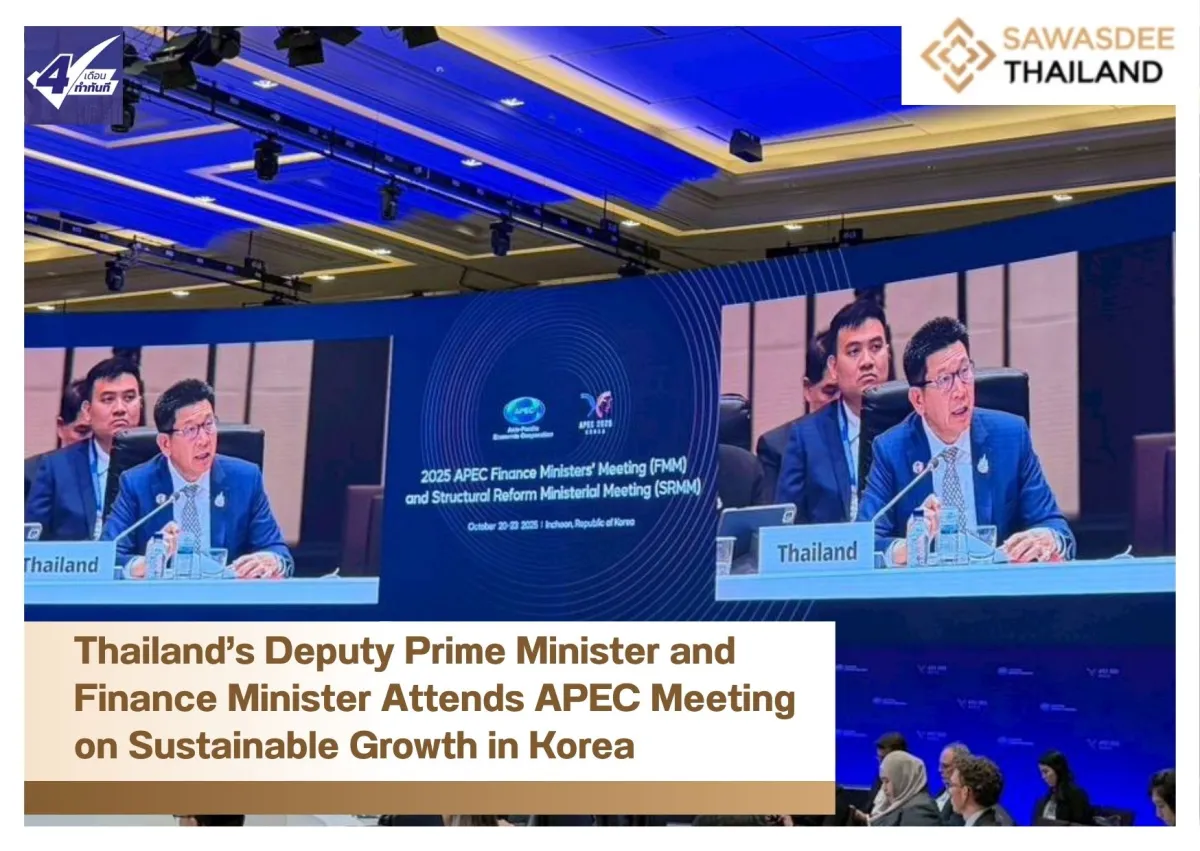
Deputy Prime Minister and Minister of Finance Ekniti Nitithanprapas is attending the 32nd APEC Finance Ministers’ Meeting (FMM), the 4th APEC Structural Reform Ministerial Meeting, and related events taking place from October 21 to 23 in Incheon, South Korea. Held under the theme “Sustainable Growth and Shared Prosperity in the Region,” the meeting gathers finance ministers and representatives from 20 APEC member economies to discuss global economic conditions, digital finance, and fiscal policy directions.
Participants voiced concern over the fragile pace of global recovery amid persistent inflation, rising public debt, labor shortages, and geopolitical uncertainty. The International Monetary Fund projects global growth at 3.2 percent in 2025, with challenges such as aging populations and rapid technological change continuing to shape fiscal and monetary priorities across the region.
Discussions on digital finance explored how artificial intelligence and digital platforms are expanding access to financial services for micro, small, and medium-sized enterprises and low-income communities. Ministers agreed on the importance of balancing innovation with strong safeguards for data protection and financial stability. Ekniti presented Thailand’s progress through the PromptPay system, the cross-border Project Nexus, and the Alternative Risk Information Score, which uses technology to promote fair and transparent access to finance.
During the session on fiscal policy, finance ministers stressed the need for efficient and high-quality spending to support sustainable growth in areas such as digital infrastructure, clean energy, and workforce development. Ekniti outlined Thailand’s “3P Approach” to fiscal management—Precision, Priorities, and Partnerships—built around data-driven policy, investment in human capital, and collaboration with the private sector to maintain fiscal discipline.
The meeting also endorsed the adoption of the 2025 APEC Joint Finance Ministers’ Statement and the Incheon Action Plan, a five-year roadmap to advance inclusive and sustainable fiscal policy, financial innovation, and regional resilience. The statement reaffirmed APEC economies’ shared goal to strengthen macroeconomic cooperation, promote long-term investment, and support stable, sustainable growth across the Asia-Pacific region.